
Every dentist eventually gets asked the same question by a nervous patient: "Do you have to use the drill?" Increasingly, the answer is no. The dental lasers market has moved well past the early-adopter phase, and most forecasts now put global revenue somewhere in the $370–$460 million range for 2026, climbing toward $600–$860 million by the early 2030s. The exact figures vary depending on which research firm you ask — and how they define "dental laser" — but the direction is consistent: mid-to-high single-digit annual growth, driven by patient demand for less painful, less invasive procedures and by dental service organizations standardizing equipment across large clinic networks. This article looks at why that growth is happening, how dental lasers actually compare to the drill in the chair next to them, what's driving the US dental lasers market specifically, and how the leading dental lasers brands stack up against one another.
A few forces are pushing adoption higher year over year. Patient demand for minimally invasive care is the biggest one — anesthesia-free procedures and faster healing times are now a selling point clinics actively market. DSO consolidation matters just as much: dental service organizations that manage dozens or hundreds of locations can standardize on one laser platform and roll it out network-wide, which accelerates unit sales far faster than one-off purchases by solo practices. Clinical indications keep expanding too — what started as a soft-tissue tool for gum contouring now covers cavity prep, implant surgery, endodontics, and even sleep and snoring therapy, giving practices more ways to justify the cost. Add in the sheer global prevalence of periodontal disease, plus diode lasers serving as an inexpensive entry point for smaller practices, and the growth curve makes sense. Erbium (Er:YAG) systems are frequently cited as the fastest-growing technology segment, reflecting rising demand for lasers that can handle hard tissue — not just gums.
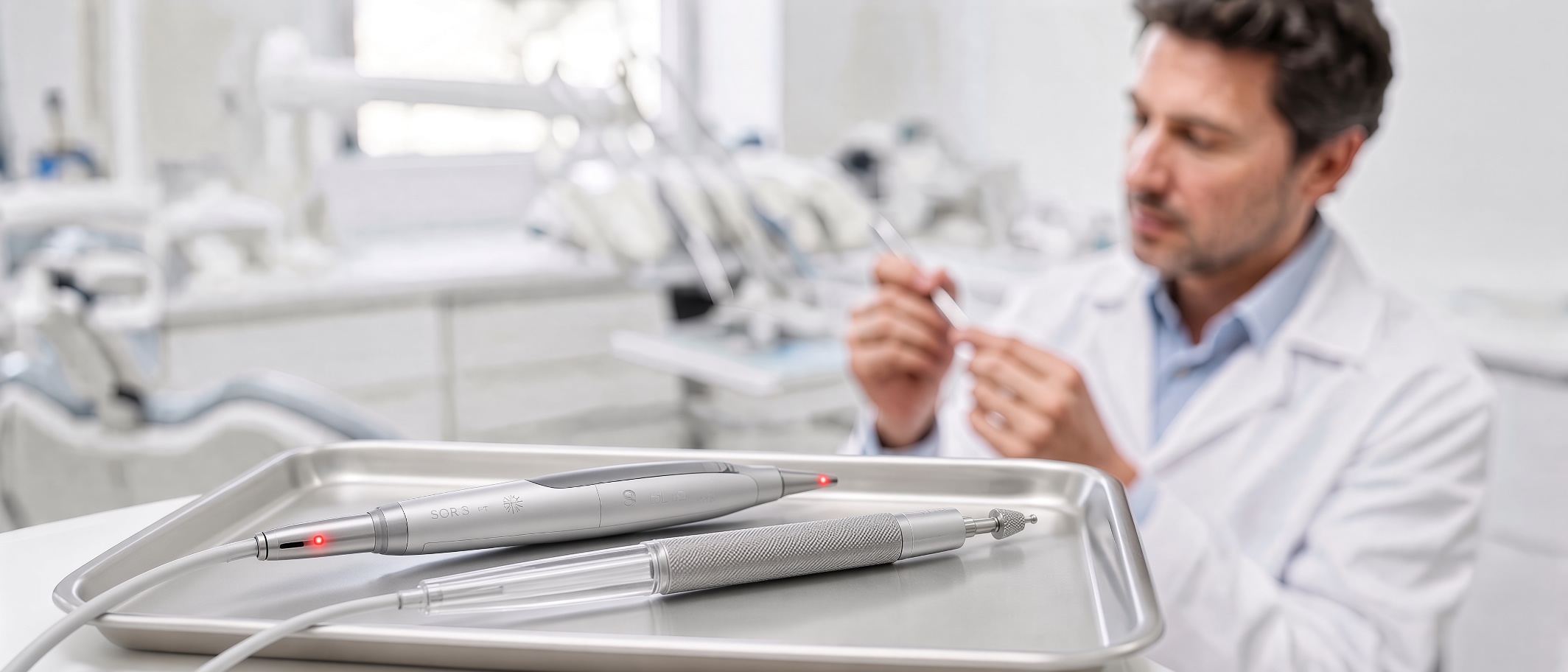
The comparison between dental lasers and drills isn't really about which tool is "better" in every case — it's about which tool suits a given procedure. Lasers tend to win on soft-tissue work: less bleeding, since the beam cauterizes as it cuts; less need for anesthesia, since lasers avoid the vibration and pressure that trigger nerve response with a drill; and a quieter, calmer experience for anxious patients. Laser energy can also disinfect the treatment site as it works, which can lower infection risk in certain procedures. Drills still hold the edge on speed for large, routine hard-tissue cases, and on cost — a high-speed handpiece is a fraction of the price of even an entry-level laser, and requires far less specialized training. In practice, most laser-equipped offices don't retire the drill at all — they use both, choosing the tool by procedure. All-tissue laser systems are the exception, built to substitute for the drill on both hard and soft tissue, though at a real price premium over a standard handpiece.
North America consistently holds the largest regional share of the global dental lasers market — commonly cited in the 40–46% range — and the US dental lasers market is the primary driver of that share. DSO growth is a major factor: the U.S. has one of the highest concentrations of large dental service organizations in the world, and centralized purchasing is repeatedly cited as a key adoption driver. The FDA 510(k) clearance pathway also shapes the market directly, since devices are cleared for a specific category of use (soft tissue only, or hard and soft tissue), which in turn shapes how manufacturers position systems to U.S. practices. Insurance coverage for laser-assisted procedures is still uneven compared to conventional treatment, and training infrastructure — more dental schools and CE programs now offering laser certification — is gradually closing the gap for solo and small-group practices. Even with strong regional growth, cost remains the most commonly cited barrier for independent U.S. practices — a mid-range all-tissue system can run well into six figures, a hard sell for a solo practitioner next to a DSO amortizing the cost across dozens of chairs.
Brand-for-brand comparisons only go so far, because the right dental laser brands landscape looks completely different depending on the size and specialty of the practice buying into it. Manufacturers like BIOLASE, Convergent Dental, Fotona, AMD Lasers, and Dentsply Sirona all sell across these tiers, so the more useful starting question isn't "which brand" — it's "which category and budget tier fits how this practice actually operates." Below is a look at how that decision typically breaks down by practice type.
The other question the market data raises is how practices are actually paying for this equipment, since the financing model shapes adoption as much as the technology does.
For a practice deciding where to start, the choice usually comes down to three questions: what procedures does the practice need to cover, who on staff will be operating the system, and what can be justified against expected procedure volume? Diode lasers remain the standard entry point precisely because they're low cost, quick to learn, and enough to cover the soft-tissue procedures every general practice performs regularly. All-tissue and multi-wavelength systems make more sense for practices that want to consolidate equipment, offer a broader menu of procedures, or reduce the number of instruments a patient is exposed to during a single visit. Within any of those categories, dental lasers brands like BIOLASE, Convergent Dental, Fotona, AMD Lasers, and Dentsply Sirona compete mainly on service support, financing terms, and training resources rather than on dramatically different clinical outcomes.
For patients, the brand behind the laser matters far less than the category. A soft-tissue laser used for a gum procedure will generally mean less bleeding and a faster recovery than a scalpel, regardless of manufacturer. An all-tissue laser used in place of a drill will generally mean less vibration and often no need for an injection — and research comparing top all-tissue platforms head-to-head has generally found their safety margins for tooth pulp to be comparable, suggesting the choice between top-tier systems often comes down to a dentist's training and preference rather than a meaningful safety gap.
Last Update: August 2026